GP38-2 406

GP38-2 406 in April 1977 near Amory, Mississippi.
Looks like northbound at Amory, Mississippi; the Mud Line is converging at the right. At about here : 33°58’11.92″N; 88°28’43.48″W
Special thanks to Karl Brand.
GP38-2 406 in April 1977 near Amory, Mississippi.
Looks like northbound at Amory, Mississippi; the Mud Line is converging at the right. At about here : 33°58’11.92″N; 88°28’43.48″W
Special thanks to Karl Brand.
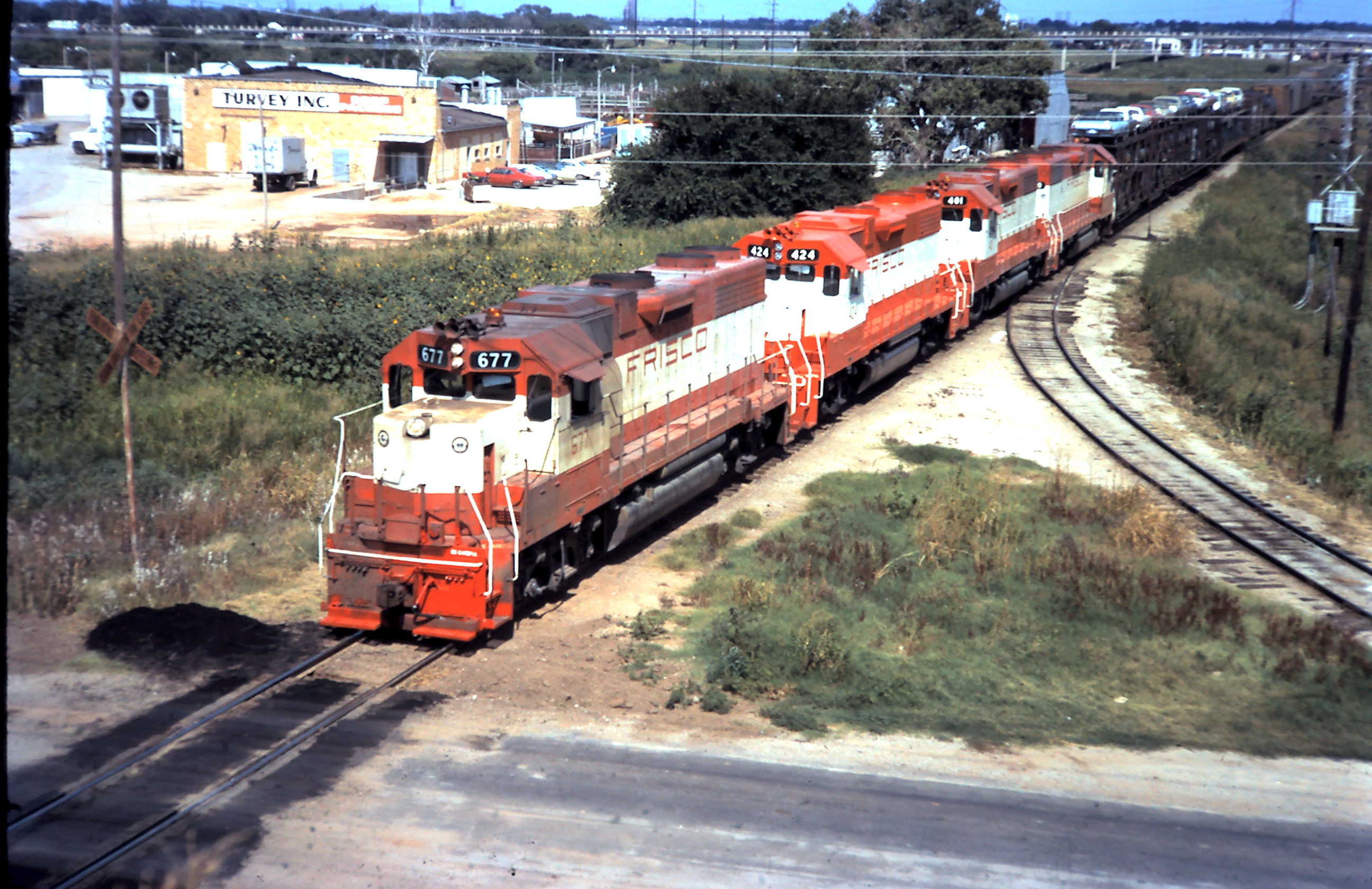
GP38-2s 677 and 424 at Oklahoma City, Oklahoma (date unknown).
The train is westbound on the Chickasha Subdivision. It has just departed the Frisco’s East Yard (MP 539.5) and crossed the North Canadian River on Bridge 539.8. This structure is 664 feet long, constructed of steel I-beams on steel piles.
The lead locomotive is just before crossing South Santa Fe Street. The photo was taken from the fill for the Santa Fe Railroad overpass. After crossing under the Santa Fe, just to the west, the train will run south of the Oklahoma City Union Station (MP 540.5). This depot was a joint operation between the Rock Island and Frisco.
The yellow building in the distance is a meat processing and packing plant. The sign identifies the business as Turvey, Inc. The red portion with white letters reads “Beef Packers”. Just to the north of the meat packer is the Producers Co-Op Oil Mill. Before shutting down in April 2015, its 37 acre facility produced cotton and canola seed products.
The view is looking northeast.
Special thanks to Mark Davidson.
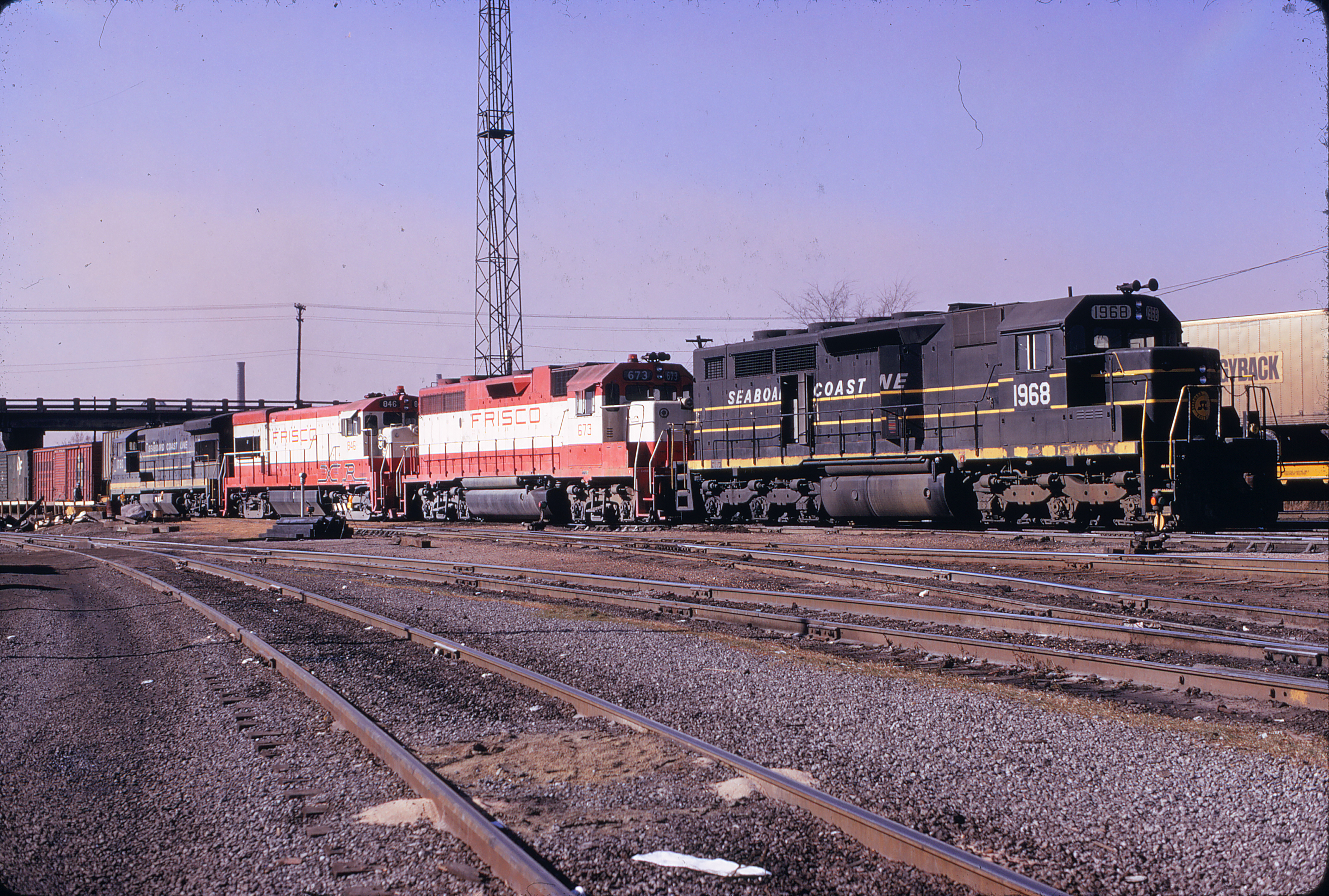
GP38-2 673 and U30B 846 at Birmingham, Alabama on December 22, 1973. (W.B. Folsom).
Also included at no additional charge is Seaboard Coast Line SDP35 1968 and U36B 1780.
1968 is a dual purpose SDP (Special Duty (6 powered axles) Passenger (steam boiler equipped)) locomotive built by the Electro-Motive Division of General Motors Corporation. In grand total only 35 units of this model were built for 4 railroads (SAL 20, ACL 1, L&N 4, UP 10).
At the time of construction, the number of passenger trains was declining and the end of passenger service was in sight. This model was intended to replace aging E and F type units in passenger service, but could easily be reverted to freight service.
This unit was constructed in November 1964 for the Seaboard Air Line (SAL) as their locomotive SAL 1117. On this line it was one of a group of twenty similar model units (SAL 1100-1119). On July 1, 1967 the SAL merged with Atlantic Coast Line (ACL) to form the Seaboard Coast Line (SCL). After this merger the locomotive was renumbered for dual passenger and freight service as SCL 618. After the railroad ended passenger service and Amtrak started it was renumbered to SCL 1968.
For a short time after its formation on December 29, 1982, the locomotive was owned by and renumbered for the Seaboard System (SBD) as SBD 4597. This later number signified a third change in use with its assignment to a group of locomotives in heavy yard switch engine service.
Later on July 1, 1986, the Seaboard System railroads (SCL, L&N, CRR, A&WP, GRR) merged with the former Chessie System railroads (B&O, C&O, WM) to form the new system of railroads, “Chessie Seaboard Transportation” (CSXT). Although the same number was blocked out for the unit, it was skipped and not used as the locomotive was retired prior to being assigned and renumbered to the CSXT 4597 slot.
The locomotive was retired on June 14, 1985. It was used as a trade-in unit for new locomotives coming from EMD. Unfortunately it was subsequently scrapped. A sister unit has been preserved, painted SAL 1114, and is on display next to the depot in Hamlet, North Carolina.
In the photograph it is easy to make out the rear car body squared end, vents and air intakes of the steam boiler compartment. This necessitated the rear steps be reconfigured to a vertical, more ladder type, orientation. This is in contrast to the “standard” inset well steps as seen at the front of the locomotive. Below the frame, between the trucks, is a two compartment combination fuel and water tank.
For rail fans and modelers, this locomotive was a Phase Ib2 unit. The phase designation recognizes largely car body variation spotting characteristics. EMD recognized model designations only and did not use “phase” designations. It rode on FC-1C trucks.
Special thanks to Mark Davidson.
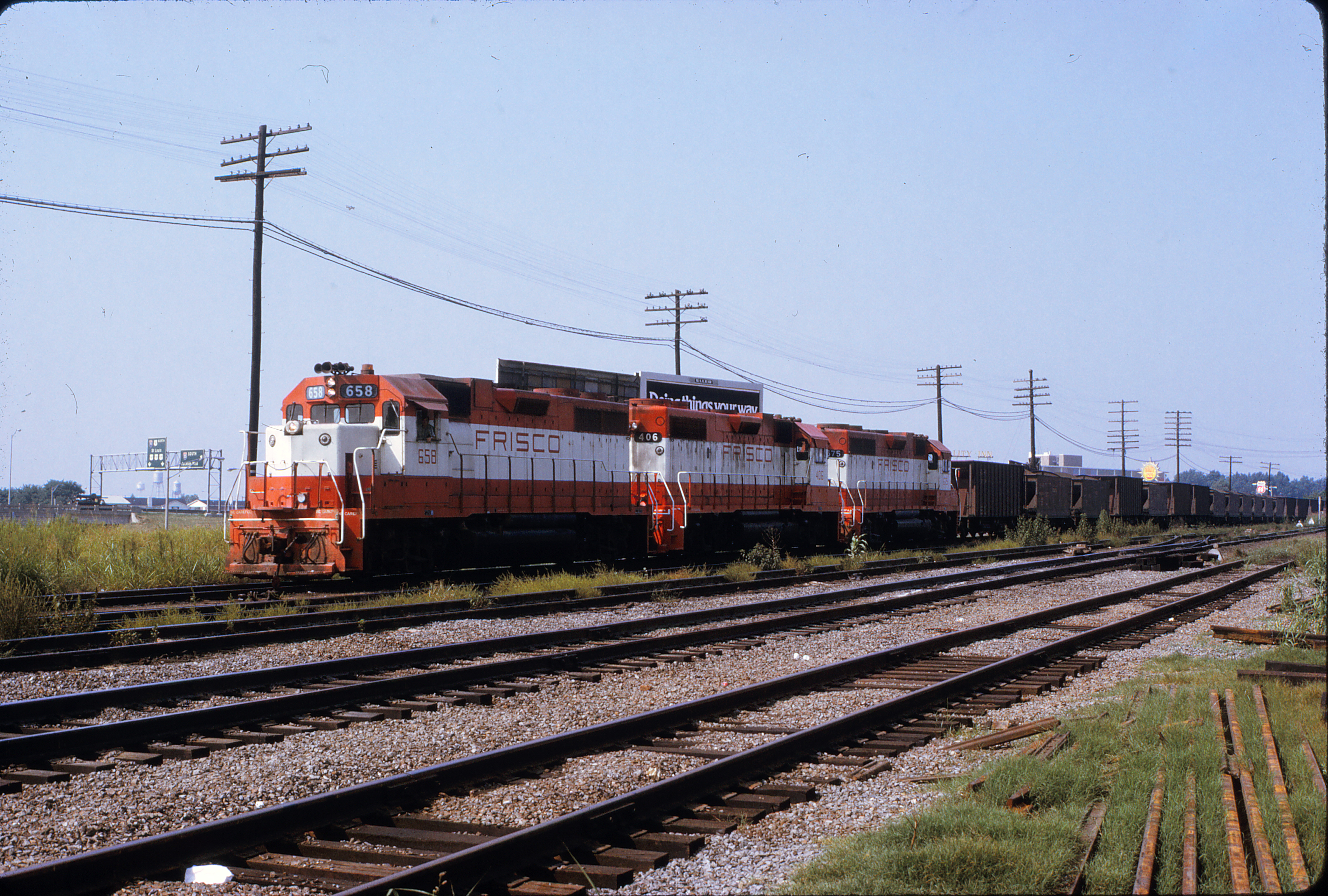
GP38AC 658 and GP38-2s 406 and 675 at Memphis, Tennessee in September 1973.
The train is southbound on the Memphis Subdivision. The locomotives have just crossed over the Mississippi River on the single track Frisco Bridge. Just off the bridge, they have passed the start of Frisco’s two main tracks through the city at Shelco (Shelby County), mile post 483.1 (MP 483.1), but are North (geographic West) of Union Railway Crossing, MP 483.6. This later point was known as Kentucky Street on the railroads to the immediate North (CRIP, MoP, SSW). In the lower portion of the photo, North of the Frisco’s tracks, are three tracks of these railroads.
At this point the train is entering the West end of “Broadway”. “Broadway” is a 2.8 mile East/West corridor of multiple tracks for various railroads extending from the two railroad river crossing bridges (Frisco and Harahan) east to KC Junction. KC Junction lies between Interstate Highway 69 (I-69) to the West and South Waldran Boulevard to the East. At KC Junction the Eastern railroads (Nashville, Chattanooga and St. Louis (NC&SL) – Louisville and Nashville (L&N), Southern (Sou), and Union Railway (URY (- OP)) diverge to their individual routes and yards to the Northeast, East and the Frisco to the Southeast.
The highway bridge in the distance is the four-leaf clover style junction with spokes of Interstate Highway 55 (West and South) at milepost exit 12, E.H. Crump Boulevard (East) and Riverside Drive (North). The westward bound left hand highway sign notes Interstate Highway 55, U.S. Highway 61 North, St Louis, U.S. Highways 64, 70 and 71. The right hand exit sign notes Interstate Highway 55 South, Jackson, Mississippi.
Out of view to the West (photo right edge) of this location are three parallel, through truss, major bridges crossing the Mississippi River. On the North (upstream) side is the Harahan Bridge (CRIP, MoP, SSW). It has double tracks, is 4,972 feet long and was opened on July 14, 1916. On the South side is the Memphis & Arkansas Bridge (“old highway” bridge). This is the most southern of the three bridges, is four vehicle lanes wide, 5,222 feet long and was opened on December 17, 1949.
Sandwiched in the middle between these is the Frisco Bridge. It has one track, is 4,887 feet long and opened May 12, 1892. When completed by the Kansas City, Fort Scott and Memphis (KCFS&M) Railway it was the first bridge crossing of the Mississippi River at Memphis.
The view is looking Southwest.
Special thanks to Mark Davidson.
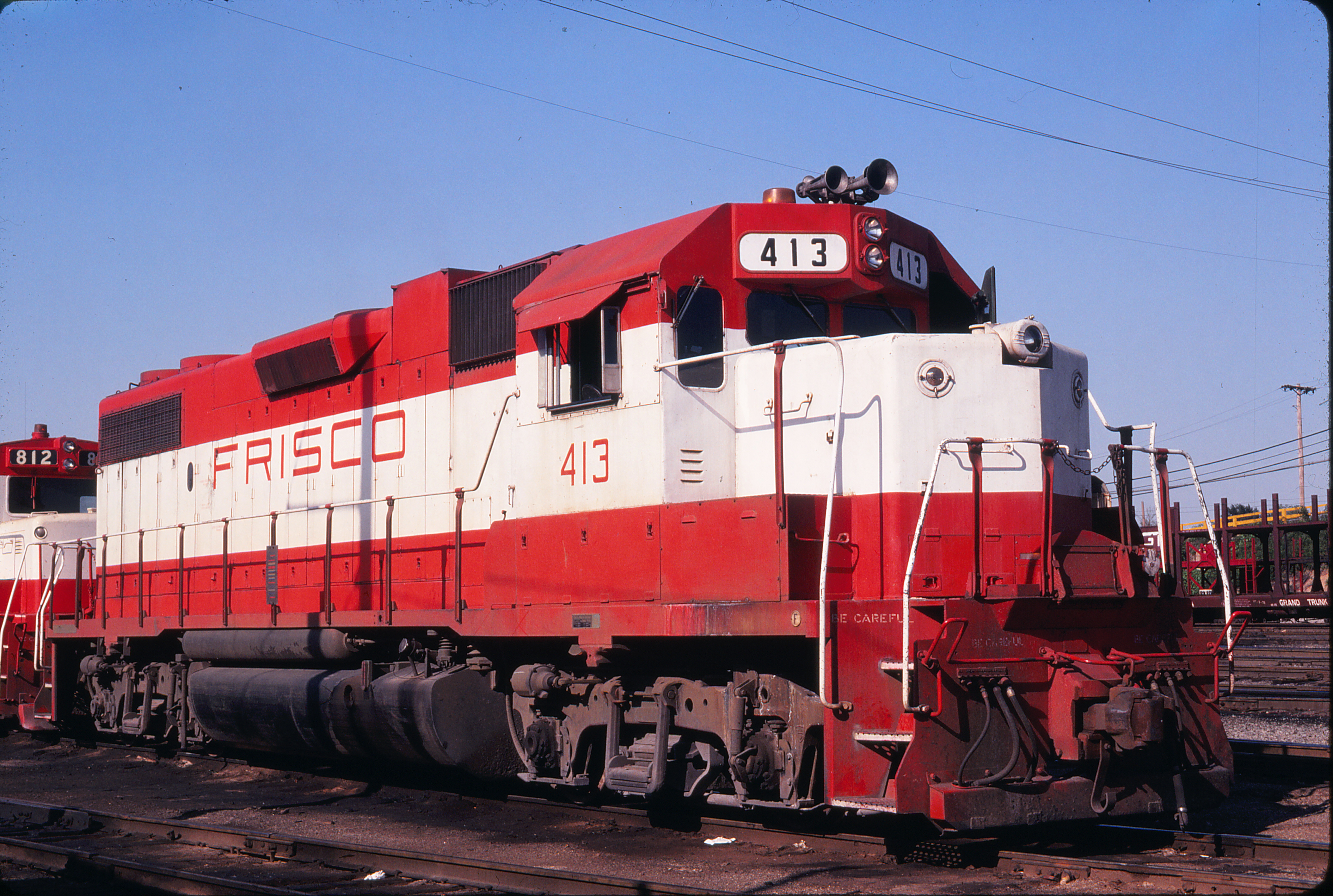
GP38-2 413 at St. Louis, Missouri in June 1979 (Michael Wise).
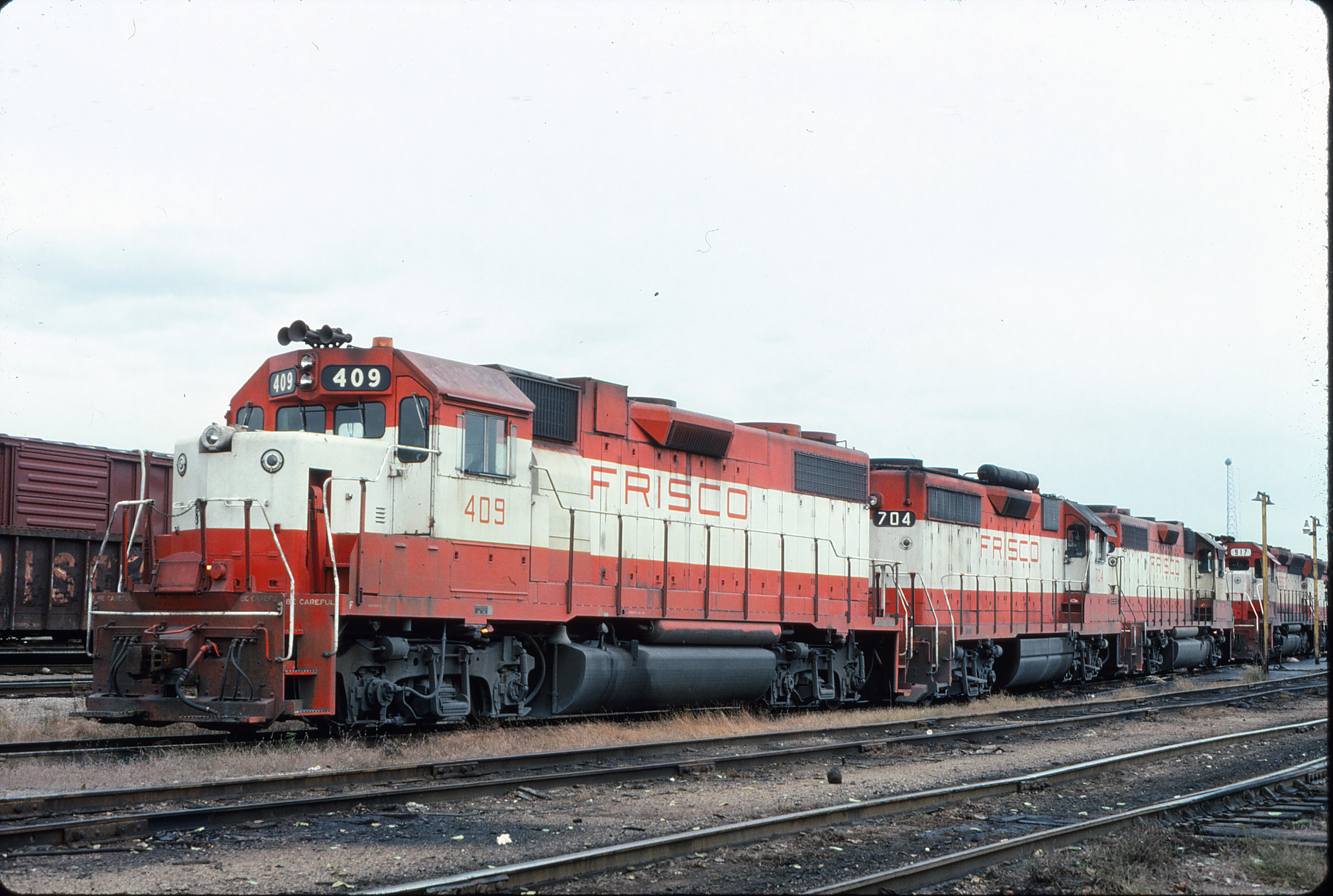
GP38-2 409 and GP35 704 at St. Louis, Missouri in October 1977.
This is the east end of the Mechanical Department’s locomotive service tracks area. Out of view further to the west is the diesel shop. This is on the north side of Lindenwood Yard. To the right and behind the photographer is the River Des Peres. It flows south along the northwest side of the yard.
Other locomotives identified in this photograph include GP38-2 676 and SD45 917. A second unidentified SD45 is on the far end.
The view is looking to the southwest.
Special thanks to Mark Davidson.
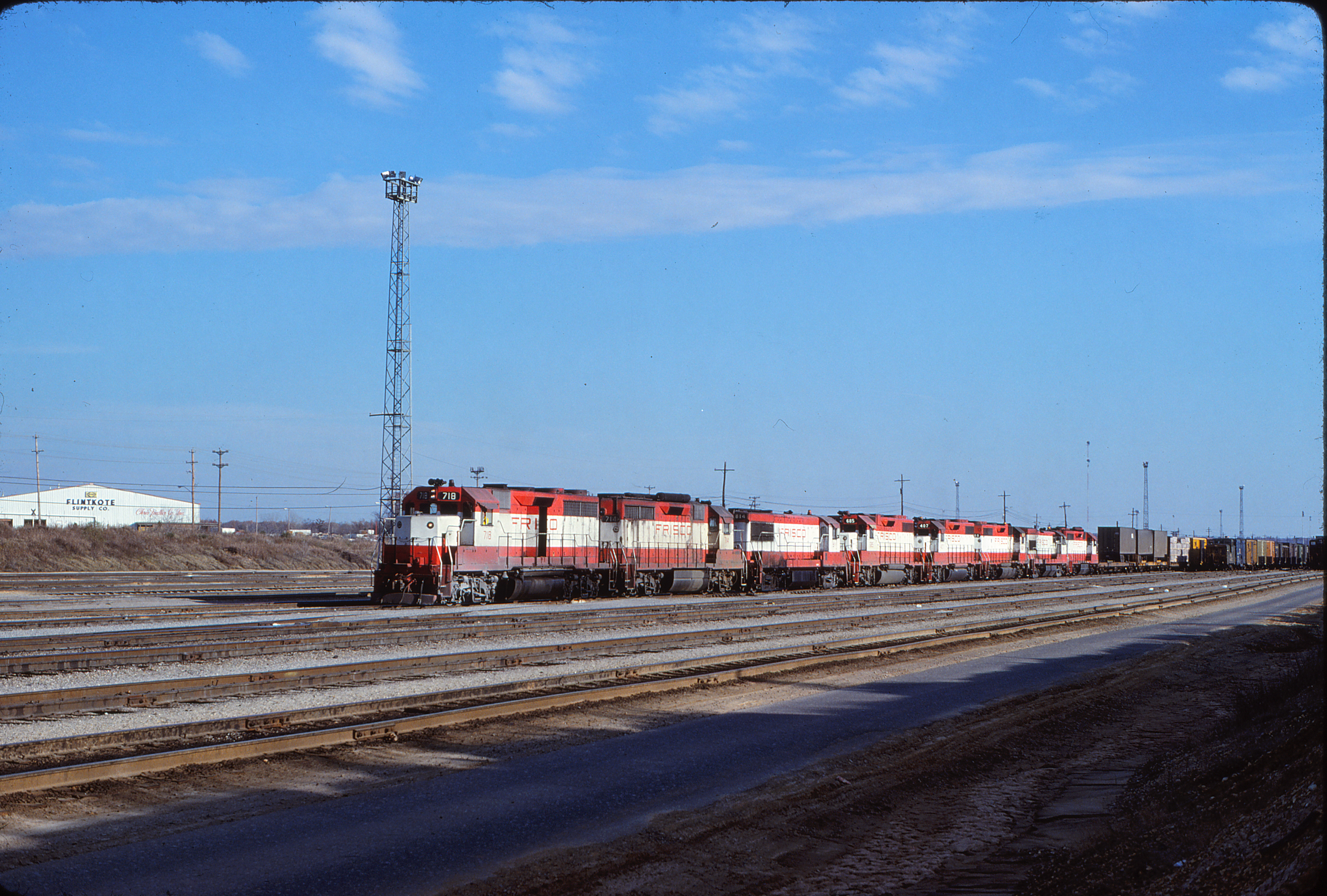
GP35s 718 and 714, U25B 814, and GP38-2s 685 and 407 at Memphis, Tennessee on January 17, 1981 (Gene Gant).

GP38-2 2338 (Frisco 667) at St. Louis, Missouri on May 27, 1981 (M.A. Wise).

Back to the bicentennial: GP38-2 440 at Fort Worth, Texas on July 4, 1976.
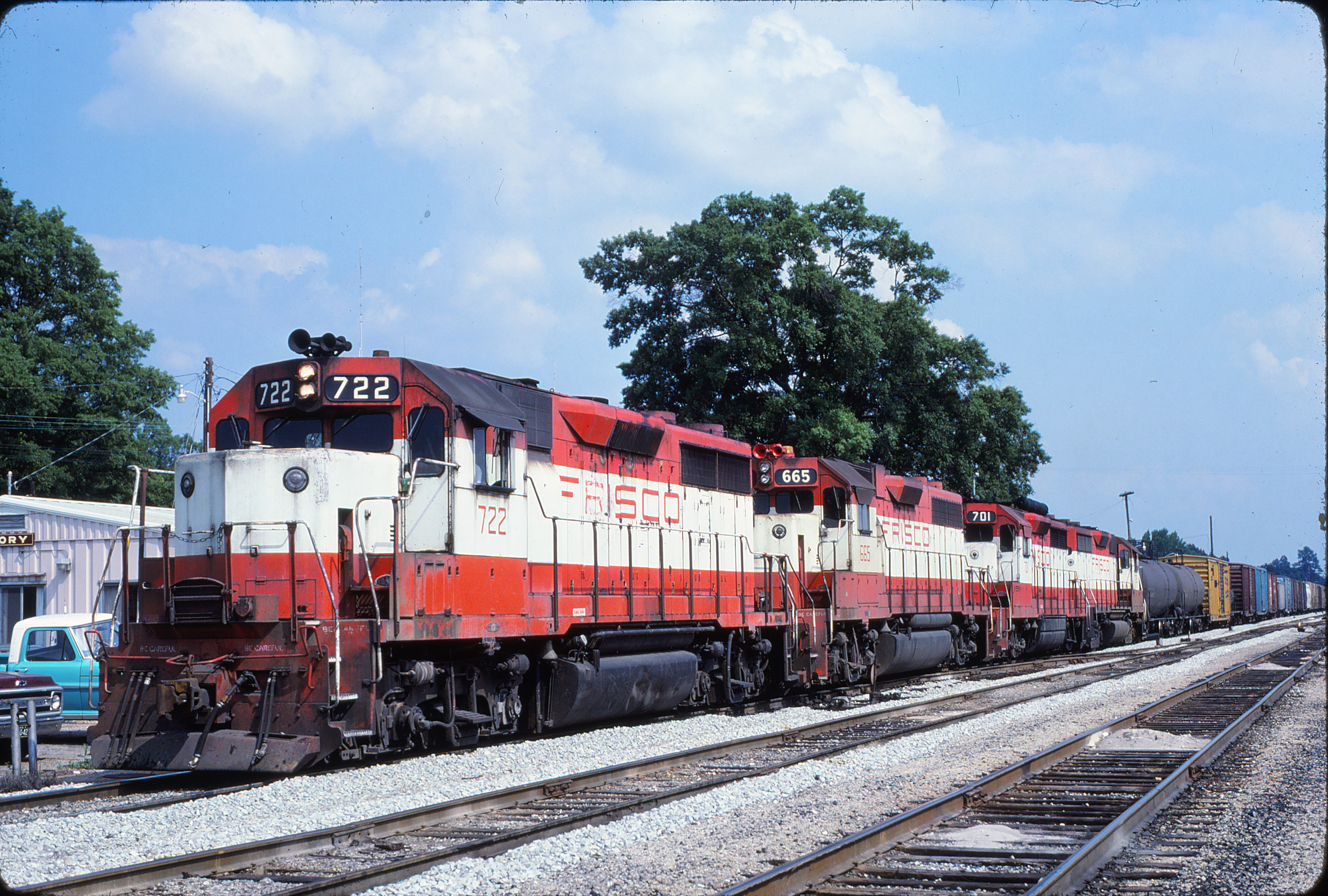
GP35 722, GP38-2 665 and GP35 701 at Amory, Mississippi in May 1980.
The train is northbound. In the background on the left is the “new” metal depot/yard office at 101 Front Street North in Amory. In the early 1970s this depot replaced the former 1916, flat roofed, eight inch tile, stucco covered passenger depot. To the right of the train are the yard, freight car and locomotive mechanical facilities.
Amory was the division point separating the Tupelo Subdivision (North to Memphis/Yale Yard/Tennessee Yard) from the Birmingham Subdivision (Southeast to Birmingham, Alabama) and the Columbus Subdivision (South to Magnolia, Mississippi and ultimately Pensacola, Florida or Aliceville, Mississippi and via the former AT&N, ultimately, Mobile, Alabama).
One half block to the Southeast of the depot the Frisco had a blond brick, two story building that housed the offices for the Southern Division. That building is now the Amory City Hall and offices. In front of the building is the city’s Frisco Park. In the Northwest corner of the park, under a steel shed roof, is Frisco 1529. This steam engine is a Mountain type, 4-8-2 wheel arrangement, built by the Baldwin Locomotive Works in 1926.
The view is looking Southeast.
Special thanks to Mark Davidson.