U30B 860

U30B 860 at North Little Rock, Arkansas on March 10, 1978 (J. Harlan Wilson).
U30B 860 at North Little Rock, Arkansas on March 10, 1978 (J. Harlan Wilson).


U30B 845 at Tennessee Yard on August 6, 1974.
Location is Memphis, Tennessee.
This is the mechanical department’s diesel service tracks area at Tennessee Yard. The locomotives are sitting on the wash rack track just northwest of the diesel shop. Additional locomotives visible in consist include SD40-2 UP 3135 and SD40 UP 3115. In the distance on the receiving and departure (R&D) yard tracks are several interesting Frisco color coded freight cars. These cars featured routing information indicating “Return to Agent Frisco Railway Memphis Tennessee”.
On the left is a blue SLSF 15500-15574 series (75 cars) 50’6” inside length, 4,828 cubic foot, smooth slab plug door boxcar. These load restraining equipped (XL) cars featured Evans DF-2 (damage free, 2nd generation) belt rails. Note these cars did not have an explanation mark (!) following the slogan “Ship It on the Frisco”. These cars were in assigned service to General Foods Corporation. General Foods products at the time included Post brand cereals including Grape Nuts and Post Toasties, Jell-O, Minute Rice, Log Cabin Syrup, Sanka and Maxwell House coffee and Birdseye brand frozen foods.
To the right are orange SLSF 15000-15099 series (100 cars) 40’6” inside length, 3,898 cubic foot, exterior-post lug door boxcars. They are in special assigned service to Kellogg Company. Memphis is host to one of the company’s cereal products plants just northeast of Frisco’s Yale Yard. Products produced at the plant have included Kellogg’s Corn and Frosted Flakes, Rice Krispies Treats and granola clusters. The plant address is 2168 Frisco Avenue, Memphis, Tennessee 38114.
Also visible in the left photograph is the west signal for the 250’ U-shaped vehicle tunnel underpass beneath the receiving and departure (R&D) tracks. This signal is interlocked to permit one way traffic through the single lane tunnel. Activating the push button at either entrance starts a timer and clears the appropriate signal. Once the signal times out, following or opposing traffic can reactivate the push button for the timer in the desired direction.
This tunnel connects the railroad service road between the mechanical department’s freight car repair-in-place (RIP) and diesel shops. A second similar 60’ tunnel runs under the north lead drill tracks into the yard bowl. It too is a single lane tunnel, though shorter in length, with interlocked vehicle traffic signals. This tunnel accessed the service road between and parallel to the yard bowl and the R&D tracks. Both tunnels are 16 feet in diameter, with a 9 foot wide roadway and include employee pedestrian walkways.
View is looking north.
Special thanks to Mark Davidson.

U30B 847 at Springfield, Missouri on March 4, 1978 (James Holder).
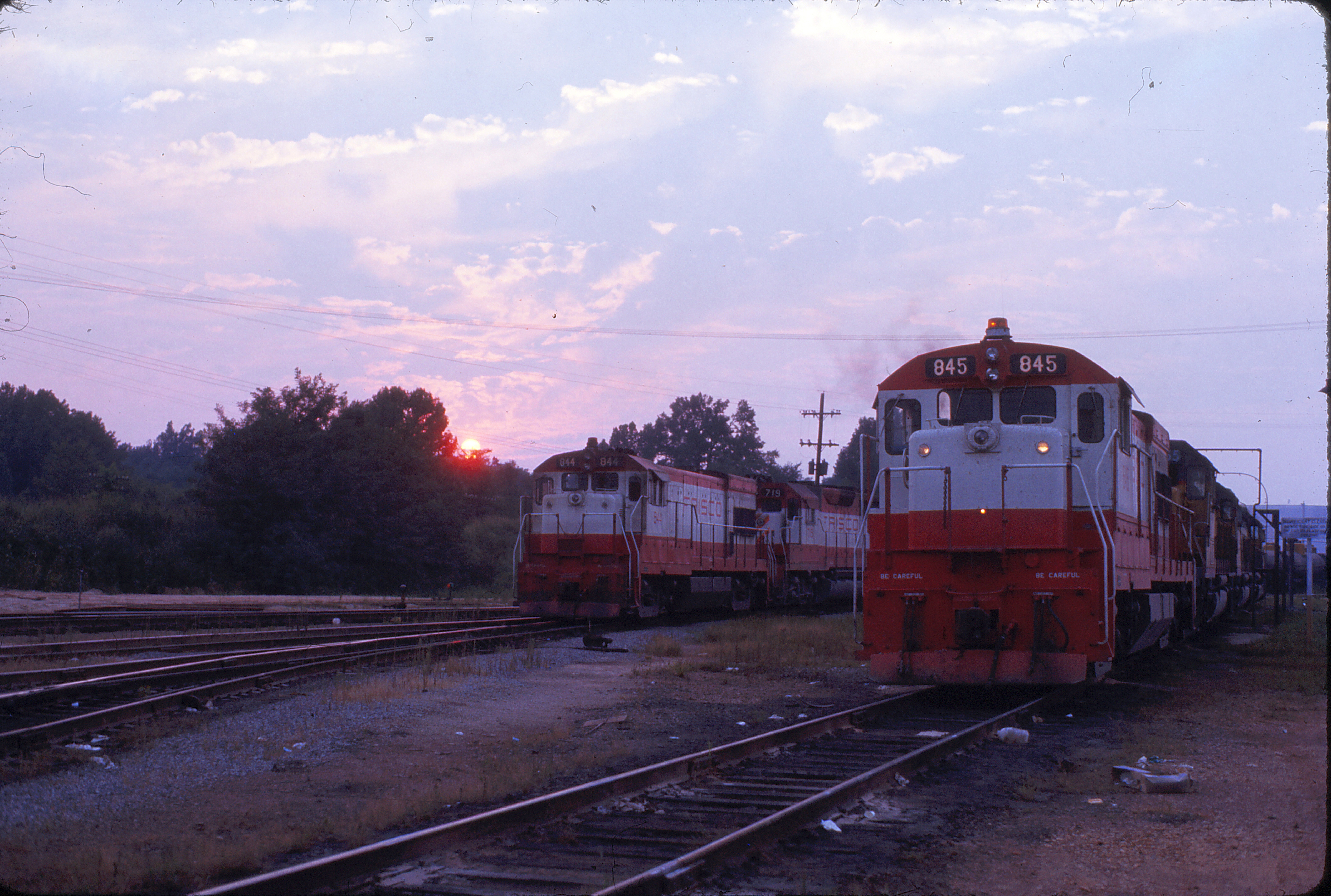
U30Bs 844 and 845 at Memphis, Tennessee on August 6, 1974.
This sunset view was taken at the Mechanical Department’s diesel service facilities at Tennessee Yard. U30B 845 and three Union Pacific units are on the locomotive wash rack track. This track leads to and is an extension of Service Track 1. The sign to the right warns, “Close clearance. Do not ride side of equipment through the wash rack piping.” Further in the distance are company service diesel fuel yellow dome tank cars. They are sitting at the two fuel unloading tracks.
The fuel unloading tracks are serviced by eight fuel unloading standpipes. Each vertical stand featured pipes with upper flexible elbow joints to swing out and reach over the top of the fuel cars. On the outer end was a flexible rubber hose that was dropped or dipped through the dome of the car to pump out the fuel. Beyond the tank cars is the large bulk fuel storage tank.
On the left, additional units are being moved on the north end of other service tracks. An additional unit identified is GP35 719. On its nose are orange diagonal stripes intended to improve the visibility of the approaching engine. The TY diesel shop is to the southeast behind the photographer. The five service tracks, plus a runaround/turntable lead, number outward to the west from the shop.
Folks interested in operations will note the different illumination configuration of each General Electric lead unit. U30B 844 has only its number boards illuminated. This indicates it will be the identifying unit for a scheduled or regular train. In contract, U30B 845 in addition to having its number boards illuminated also is displaying white class lights. These lights are high on its nose near the outer corners. This combination indicates that consist is power for an extra train.
The view is looking northwest.
Special thanks to Mark Davidson.
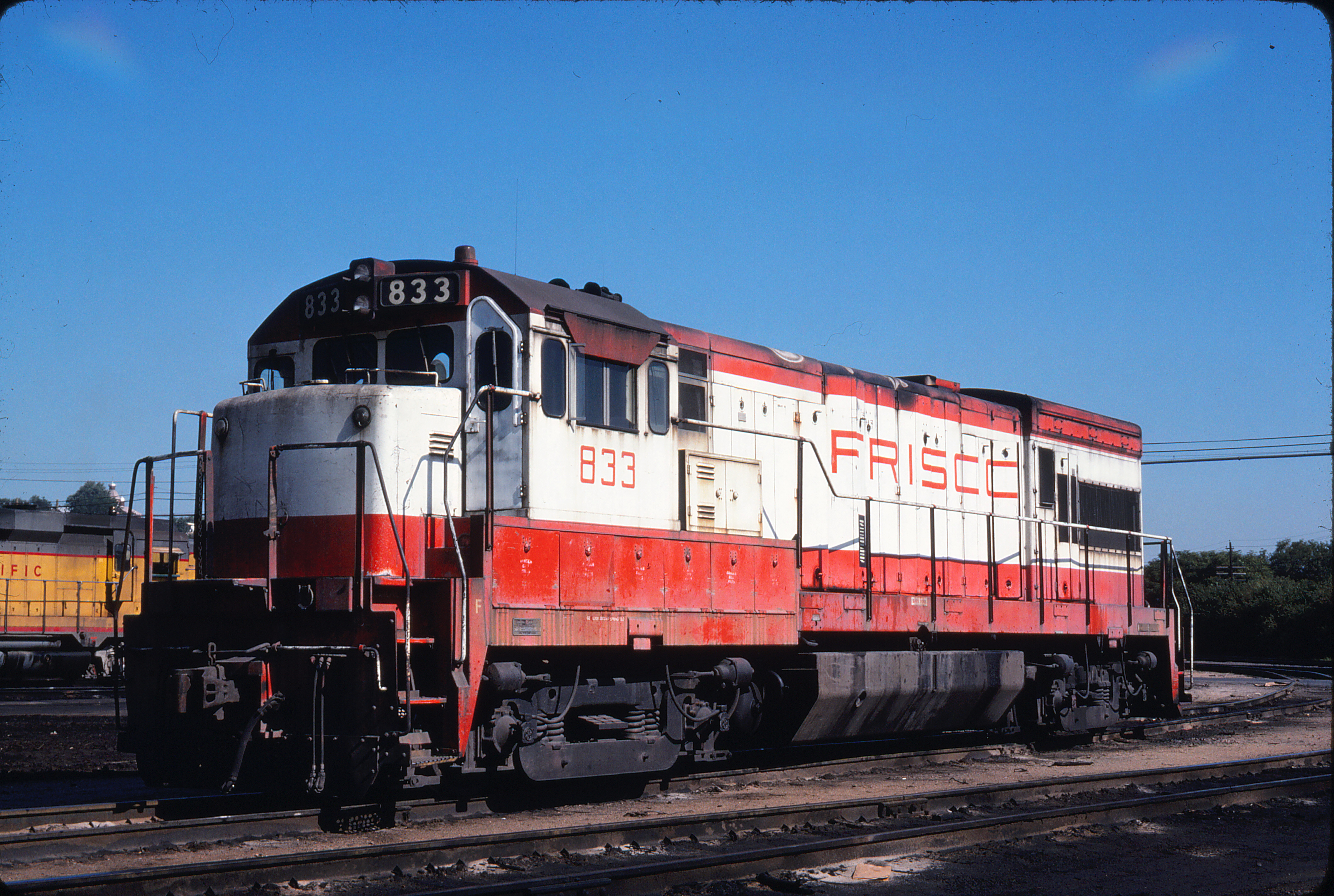
U30B 833 at Kansas City, Kansas in September 1978 (Michael Wise).
This photograph was taken in Armourdale Yard of the Union Pacific (UP) Railroad. This yard is in the Kansas River bottomland, 1.5 miles south of the city’s downtown. Their engine service facilities were near the middle of the yard, south of the railroad’s modern freight house. Beyond the nose of the subject locomotive is a GP30 of the host railroad.
Above the UP engine, in the distance on the river bluff, is the top of an onion shaped church spire. This is the “Old” Holy Trinity Orthodox Church, founded in 1917, at 557 Lowell Avenue. The church is in the historic Russian Hill section of the larger Strawberry Hill neighborhood.
To the right of the locomotive in the tree and pole line is the northwestern branch of the Kansas City Terminal (KCT) Railway’s elevated High Line. Its north end ascends from North Cypress Junction, south of James Street. This branch continues south, east of and parallel to Interstate 70, west of the Kansas River. As seen in this view it is just before crossing over Armourdale Yard.
South of the yard it then joins its western branch ascending from Terminal Junction, under the Seventh Street overpass. These routes join at High Line Junction. The junction is over Berger Avenue, just west of its intersection with Adams Street. The two lines then continue in a generally southerly direction, cross the Kansas River on a double deck, 4 track (2 each level), hydraulic lift bridge.
Continuing on the route passes over the Kansas/Missouri state line. Just beyond, at State Line Junction, the lines split again. One branch turns northeast descending toward Kansas City Union Station (KCUS). The other line diverts to the southwest, passes closely to the west of the KCT roundhouse and descends to 29th Street Interlocking.
The view is looking north.
Special thanks to Mark Davidson.
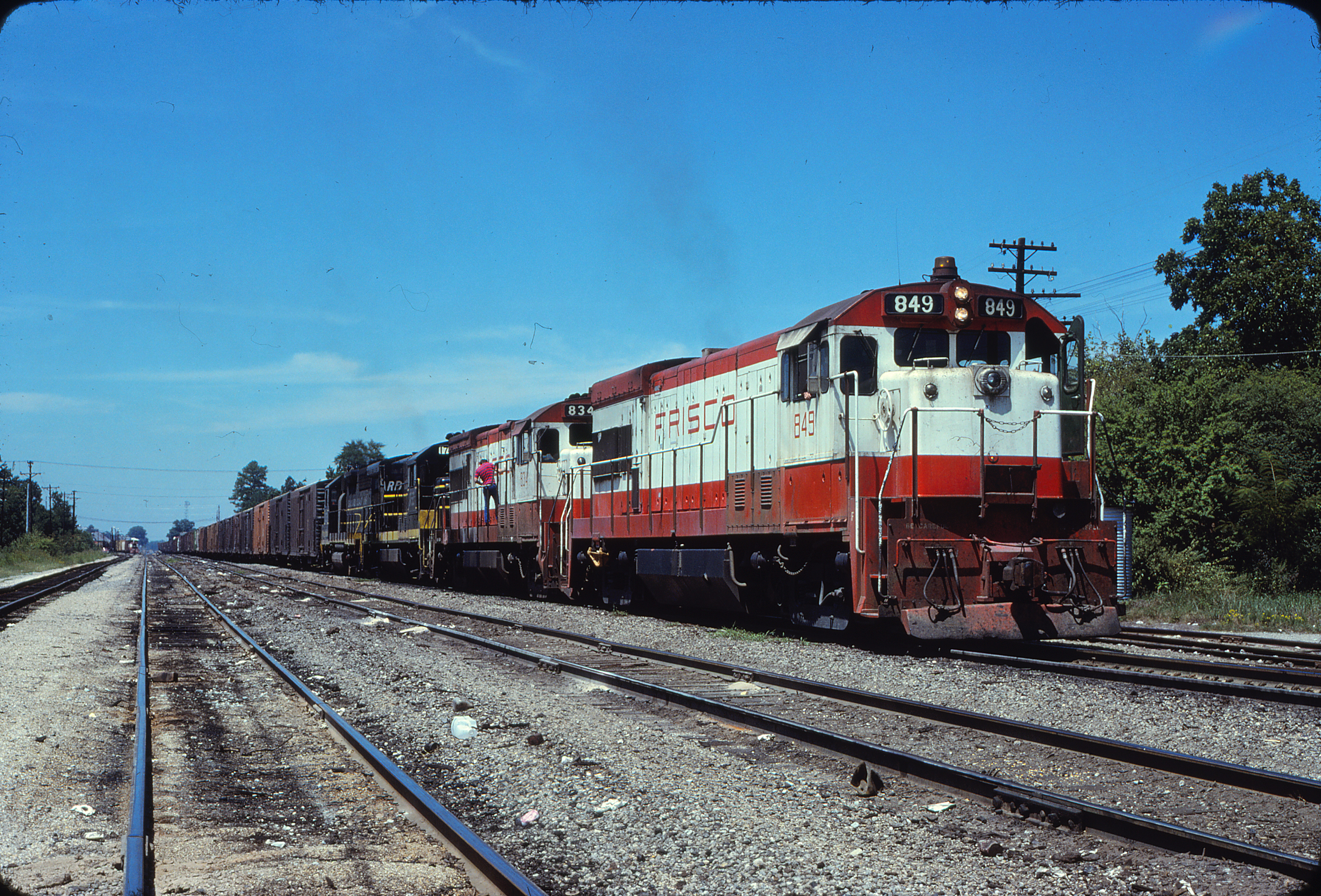
U30Bs 849 and 834 at Amory, Mississippi in August 1978 (J. Oates).
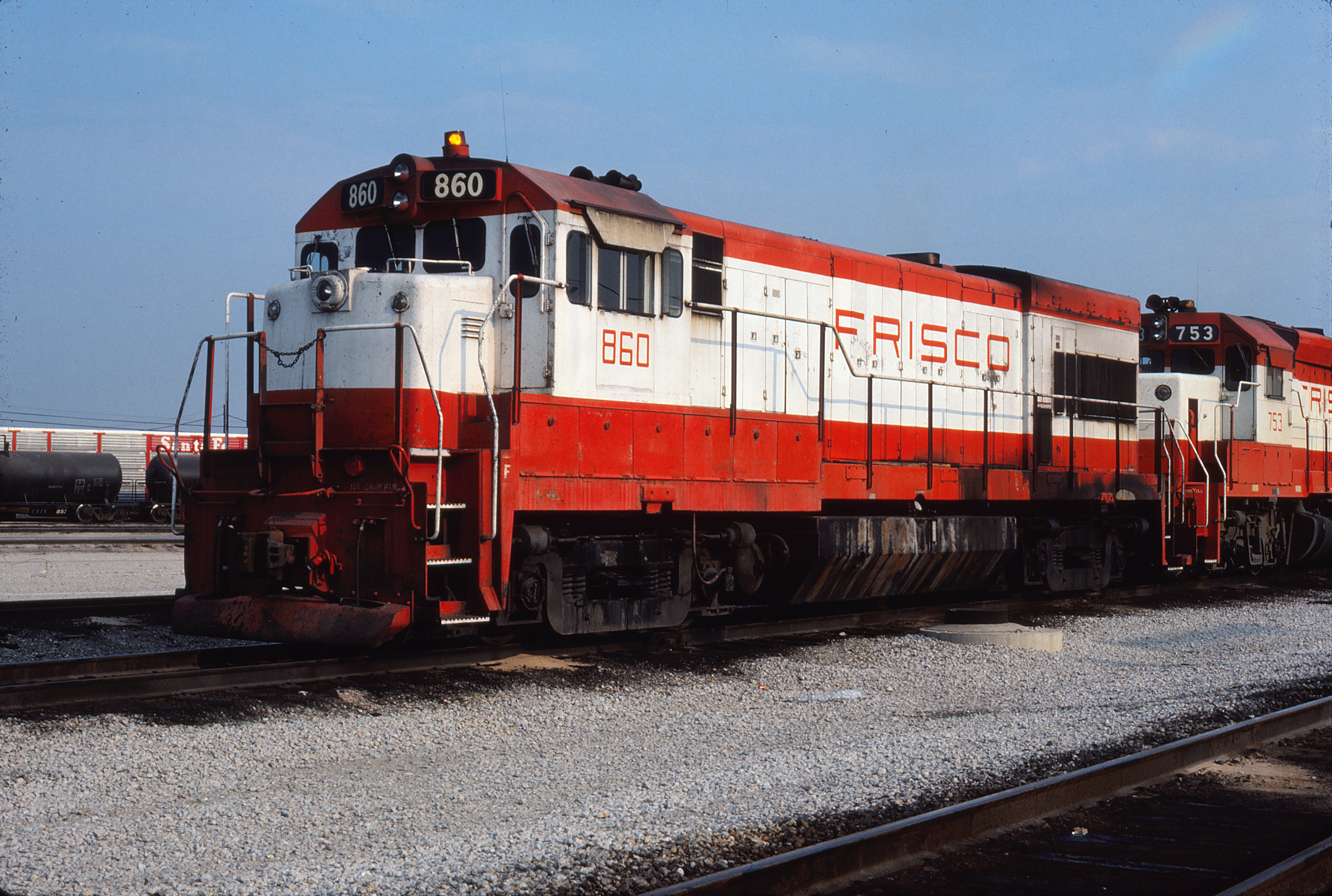
U30B 860 at Tulsa, Oklahoma on July 14, 1980 (Gene Gant).

SD45 916 and U30B 861 at Springfield, Missouri on January 5, 1980.
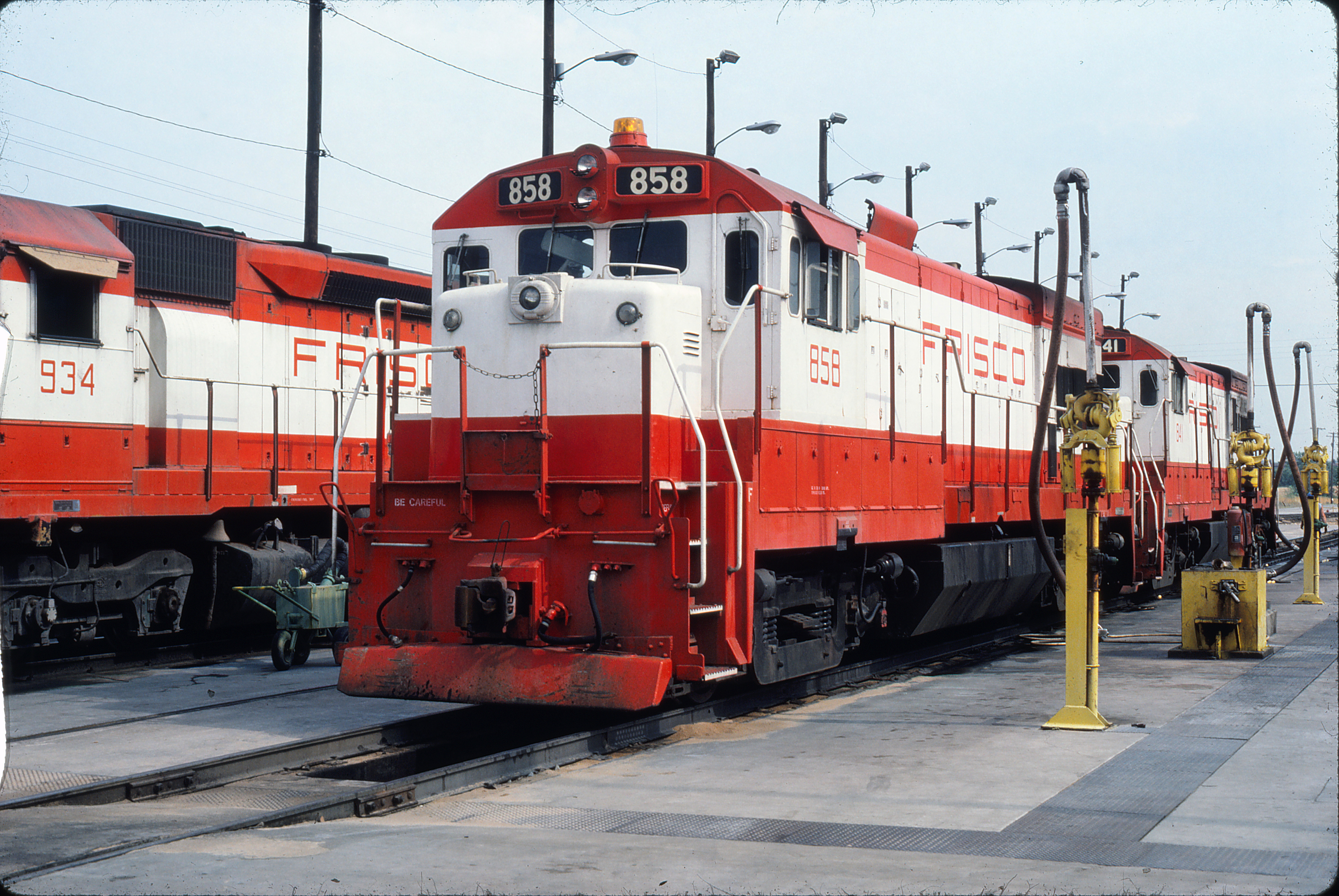
U30B 858 at Tulsa, Oklahoma on July 14, 1980.
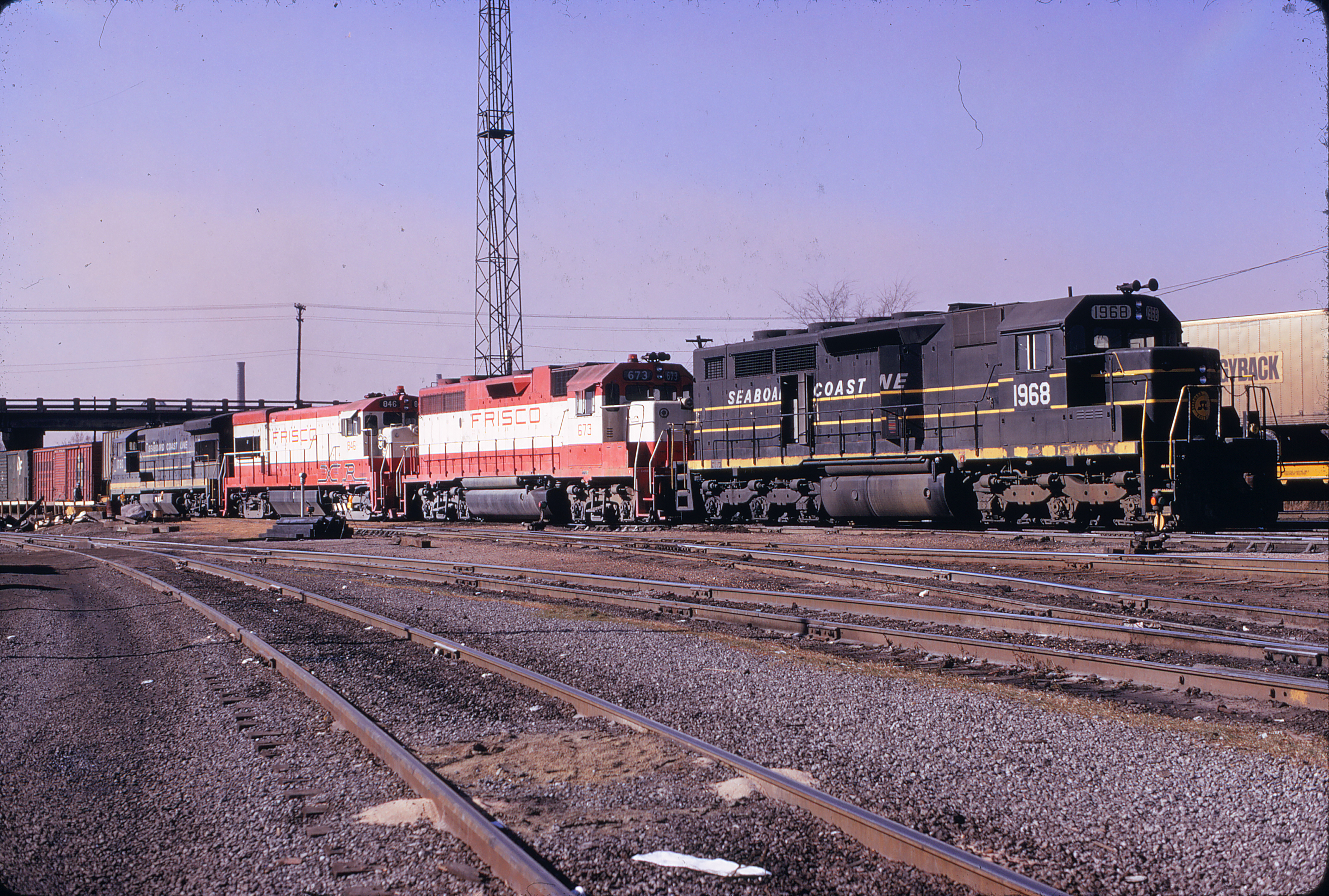
GP38-2 673 and U30B 846 at Birmingham, Alabama on December 22, 1973. (W.B. Folsom).
Also included at no additional charge is Seaboard Coast Line SDP35 1968 and U36B 1780.
1968 is a dual purpose SDP (Special Duty (6 powered axles) Passenger (steam boiler equipped)) locomotive built by the Electro-Motive Division of General Motors Corporation. In grand total only 35 units of this model were built for 4 railroads (SAL 20, ACL 1, L&N 4, UP 10).
At the time of construction, the number of passenger trains was declining and the end of passenger service was in sight. This model was intended to replace aging E and F type units in passenger service, but could easily be reverted to freight service.
This unit was constructed in November 1964 for the Seaboard Air Line (SAL) as their locomotive SAL 1117. On this line it was one of a group of twenty similar model units (SAL 1100-1119). On July 1, 1967 the SAL merged with Atlantic Coast Line (ACL) to form the Seaboard Coast Line (SCL). After this merger the locomotive was renumbered for dual passenger and freight service as SCL 618. After the railroad ended passenger service and Amtrak started it was renumbered to SCL 1968.
For a short time after its formation on December 29, 1982, the locomotive was owned by and renumbered for the Seaboard System (SBD) as SBD 4597. This later number signified a third change in use with its assignment to a group of locomotives in heavy yard switch engine service.
Later on July 1, 1986, the Seaboard System railroads (SCL, L&N, CRR, A&WP, GRR) merged with the former Chessie System railroads (B&O, C&O, WM) to form the new system of railroads, “Chessie Seaboard Transportation” (CSXT). Although the same number was blocked out for the unit, it was skipped and not used as the locomotive was retired prior to being assigned and renumbered to the CSXT 4597 slot.
The locomotive was retired on June 14, 1985. It was used as a trade-in unit for new locomotives coming from EMD. Unfortunately it was subsequently scrapped. A sister unit has been preserved, painted SAL 1114, and is on display next to the depot in Hamlet, North Carolina.
In the photograph it is easy to make out the rear car body squared end, vents and air intakes of the steam boiler compartment. This necessitated the rear steps be reconfigured to a vertical, more ladder type, orientation. This is in contrast to the “standard” inset well steps as seen at the front of the locomotive. Below the frame, between the trucks, is a two compartment combination fuel and water tank.
For rail fans and modelers, this locomotive was a Phase Ib2 unit. The phase designation recognizes largely car body variation spotting characteristics. EMD recognized model designations only and did not use “phase” designations. It rode on FC-1C trucks.
Special thanks to Mark Davidson.